
Once a year, on a date that nobody can put in a calendar more than a few weeks ahead, tens of thousands of people walk onto a beach on the south coast of Lombok in the dark, wade into the shallows with nets and buckets, and catch sea worms.
This is Bau Nyale — bau meaning “to catch” in Sasak, nyale being the worms themselves. It is the largest and oldest event on the Sasak cultural calendar, and it happens roughly forty minutes from where we live. Most English-language writing about it is a paragraph in a listicle. This is the longer version: what actually happens, when, why, and whether it is worth planning a trip around.
When is Bau Nyale 2027?
The honest answer, as of August 2026: nobody knows yet, and anyone who tells you a specific date is guessing.
Here is how it actually works. The date is not fixed by the Gregorian calendar and it is not decided by the tourism board. It is set by Sangkep Warige — a traditional assembly of Sasak elders, customary leaders and community representatives who meet, deliberate, and announce the date a few weeks or months before the event.
The pattern from last year tells you what to expect:
- Bau Nyale 2026 fell on 7–8 February 2026, centred on Seger Beach in the Mandalika area.
- That date was announced on 4 December 2025, at a Sangkep Warige gathering held at the Mandalika Circuit, with customary leaders, cultural figures and the Central Lombok regency administration present.
So for 2027, the reasonable expectation is an announcement in early December 2026 for a festival somewhere in the late January to mid-February 2027 window. We will update this page the day the date is confirmed.
The underlying rule is lunar. Nyale traditionally appear on the twentieth day of the tenth month of the Sasak calendar, around the full moon — which lands in February or, some years, March. This is also why the worms actually turn up: their spawning is genuinely synchronised to the lunar cycle. The tradition and the biology are describing the same event.
The legend of Princess Mandalika
Every Sasak child knows this story, and you will hear it a dozen times during the festival.
Princess Mandalika, daughter of King Kuripan, was so beautiful and so beloved that princes from every corner of Lombok came to ask for her hand. Each was powerful. Each was willing to go to war over her. Choosing one meant condemning her people to fighting among themselves.
On the twentieth night of the tenth month, she summoned all of them to Seger Beach. She told the assembled crowd that her love for her people was greater than any love she could give a single man — and that if she could not be one man’s wife, she would be everyone’s. Then she climbed the headland above the beach and threw herself into the sea.
When her people searched the water, they found no body. They found millions of sea worms. In one telling the nyale are her hair; in another, she herself, returning in a form that everyone can share. She had promised to come back to her people on the same night every year, and — as far as anyone here is concerned — she does.
The headland she is said to have jumped from is still there, at the eastern end of Seger Beach. You can walk up it.
What the nyale actually are
They are marine worms, and the biology is nearly as strange as the legend.
Nyale are a palolo worm (Palola viridis, long known as Eunice viridis), a polychaete that lives in crevices in coral reef. For most of the year you would never see one. Then, once annually, triggered by a combination of season, tide and moon phase, the worm does something remarkable: the rear half of its body reorganises itself into a sac of eggs or sperm, detaches from the front half, and swims to the surface on its own — complete with a rudimentary eye to find the light.
Because every worm on the reef does this on the same night, the sea near the shore fills with them at once. They come in browns, creams, reds and greens, and they writhe. Within hours the sacs burst, the water clouds, fertilisation happens, and it is over for another year. The animal that stayed behind in the reef regenerates and lives on.
So the thing people are catching in the dark is, precisely, the reproductive half of several million worms, released simultaneously. It is one of the more spectacular mass-spawning events in the ocean, and Lombok is one of the few places on earth where an entire culture turns up to meet it.
What actually happens during the festival
Bau Nyale is not one night. The catch itself is the climax, but the surrounding days carry a full programme of cultural events, and in recent years the regency and the tourism office have built a substantial festival around it in the Mandalika area.
The catch, before dawn
The core ritual begins in the dark, typically from around 4am, timed to the low tide. People wade into the shallows with hand nets, plastic buckets, torches and phone lights. Families come together. Children are the most enthusiastic catchers by a wide margin. The mood is closer to a village party than a solemn rite — loud, cheerful, and extremely crowded.
By sunrise it is largely finished, and the beach turns into a long, sandy breakfast.
Peresean
If you see one thing besides the catch, see this. Peresean is Sasak stick fighting: two men, each with a rattan cane and a hide shield, facing off in a ring while a pekembar referees and gamelan plays. It is not choreographed. Strikes land, welts appear, and the crowd reacts accordingly. Historically it was practised to bring rain and to prove courage; it is now performed at nearly every major Sasak celebration.
It is genuinely arresting to watch, and it is one of the few living martial traditions in Indonesia that has never been turned into a tourist show.
Gendang Beleq
Beleq means “big”, and the drums are exactly that — carried on shoulder straps, played in a moving ensemble with gongs and reed instruments. Gendang Beleq was once music for warriors going to battle; now it opens processions and accompanies the Putri Mandalika pageant, in which a young woman is selected to represent the princess and is carried to the beach.
You will hear it before you see it. It carries a very long way.
How to attend
Get there very early. The catch is at low tide before dawn. Traffic into the Kuta and Mandalika area on the night of the festival is heavy, parking fills, and roads near the beach are managed. Leaving at 3am is not excessive.
Bring a torch, and shoes you do not mind ruining. You will be walking on wet sand and rock in the dark, in a crowd.
Expect crowds, not solitude. This is a mass event of national significance, not a hidden ceremony. Tens of thousands of people attend. If you want the atmosphere without the crush, the daytime cultural programme over the surrounding days is far calmer than the pre-dawn beach.
Dress modestly. It is a religious and cultural occasion for the people around you, whatever it looks like at 4am.
February is the wet season. This matters and most guides skip it. Lombok’s rains peak between December and February. You may get a warm, still, perfect night; you may get a downpour. Bring a light rain layer and accept the coin-flip. The rain is also part of why the nyale come — Peresean was traditionally fought to summon it.
Yes, people eat them. Nyale are cooked in banana leaf as pepes, mixed into sambal, or eaten raw by the brave. They are also scattered on rice fields, because a good nyale year is held to mean a good harvest. You are not obliged to try them. Somebody will offer.
Where to stay
Most visitors base themselves in Kuta Lombok, which is the closest town to Seger Beach and where the festival infrastructure is concentrated. It is also, on that particular night, the busiest place on the island. Accommodation in Kuta books up and prices rise.
The alternative is to stay further west along the south coast — Selong Belanak, Serangan, Mawun — and drive in. It is around forty minutes to Seger from our stretch of coast, which is a real cost at 3am, but it means you return afterwards to somewhere quiet, with a pool and a bed, instead of to a town that is still awake.
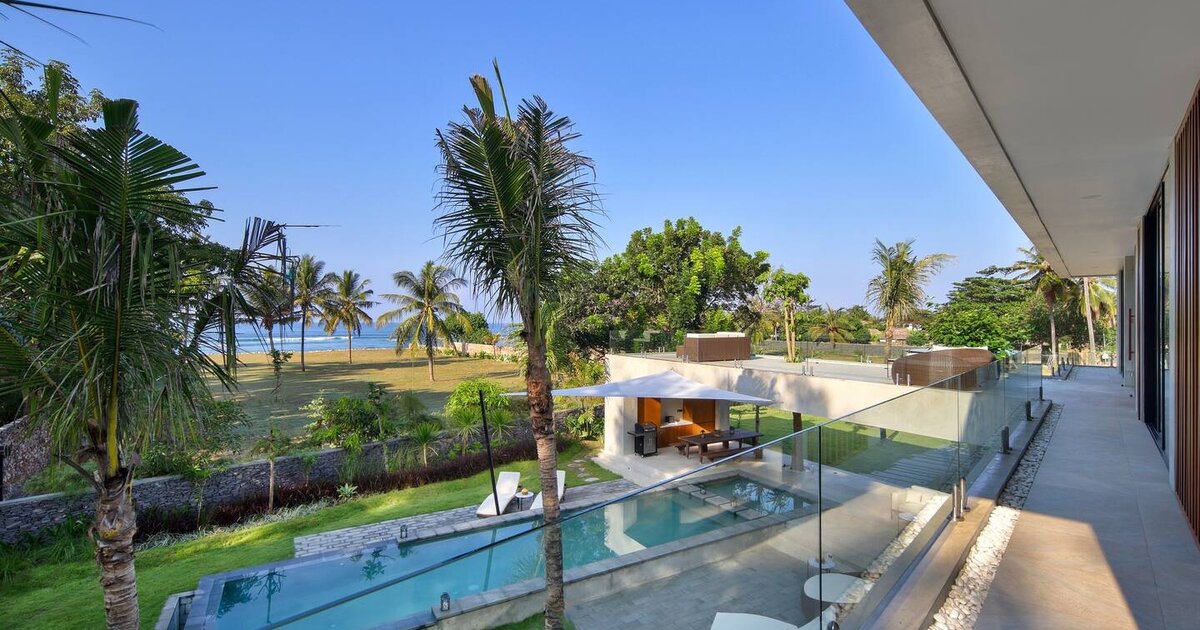
We are on that western stretch. Our two private villas sit in 2,000 sqm of gardens above Pantai Serangan, and we can arrange a driver for guests — the drive is the only sensible way to do the pre-dawn trip. If you are weighing up the coast more broadly, our guide to South Lombok’s beaches covers what each bay is actually like, and our when to visit page is honest about what February weather does.
Is it worth planning a trip around?
If you want a comfortable, curated cultural performance, no. Bau Nyale is crowded, wet, chaotic and starts in the middle of the night, and nobody is running it for your benefit.
If you want to stand in the dark on a beach with thirty thousand people who have all come to keep a nine-hundred-year-old promise to a princess who may or may not have existed, and to catch a worm that has spent a year in a reef waiting for exactly this moon — then it is one of the most extraordinary things you can do in Indonesia, and almost no foreign visitors are there.
February is the quietest month on this coast. That is exactly why the one week worth coming for is the one nobody outside Lombok has heard of.
We will update this guide as soon as the 2027 date is announced by Sangkep Warige, expected in early December 2026.
Ready to see the shore for yourself?