
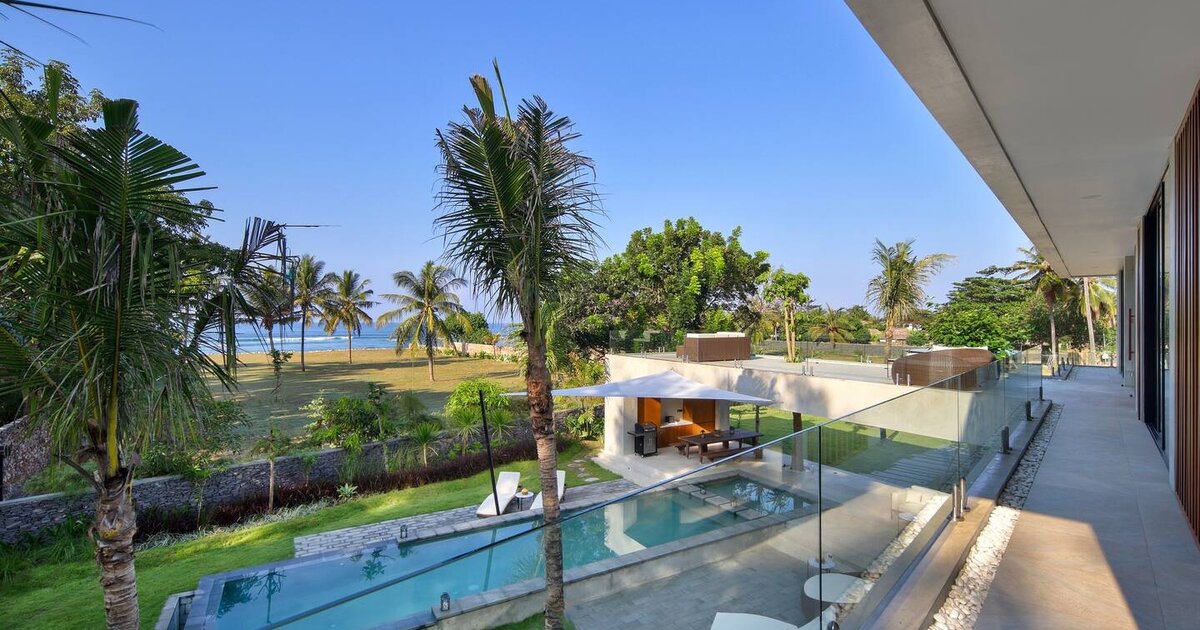
The south coast of Lombok is a run of bays and headlands roughly forty kilometres long, and the question we are asked more than any other before a booking is some version of: where along it should we actually stay? It is a fair question. The coast looks compact on a map and is not compact in practice — the road winds, the bays are separated by hills, and where you sleep quietly decides what your week looks like.
There are really three answers. Kuta and the Mandalika area, which is the hub. Selong Belanak, which is the beach. And the string of quieter bays either side of Selong Belanak, which is where we are. We run two villas there, so we have an interest in the conclusion; we have tried to write this the way we would explain it to a friend anyway, including the parts that do not favour us.
The short version
- Kuta and Mandalika if you want choice on foot — restaurants, bars, surf schools, scooter hire — and you are happy to trade quiet for convenience.
- Selong Belanak if the beach itself is the point: a long, gentle, swimmable bay with the best learner surf on the island.
- The quiet bays — Mawun, Tampah, Mawi, Serangan — if you want empty sand, a private pool and a slower day, and you are content to drive for dinner some evenings.
Whichever you choose, you will want a car and driver for at least part of the week. Nothing on this coast is walkable from anywhere else.
First, why the south at all
Lombok International Airport sits in the south of the island. The south-coast beaches are about 40 minutes from the arrivals hall on a sealed, direct road. Senggigi and the boat to the Gili Islands are two to three hours north. That single fact settles the question for most visitors with a week or less: the south is where the airport is, where the surf is, and where the beaches that people fly here for actually are.
The Gilis are a different sort of holiday — small islands, no cars, snorkelling off the beach — and worth doing as a boat day or a two-night add-on. As a base for the south coast they do not work. If your plan is beaches and surf, start here and visit north, not the other way round. Our getting here page covers the practicalities.
Kuta and Mandalika: the hub
Kuta Lombok is the only place on the south coast that functions as a town. It has the concentration of restaurants, cafés, bars, ATMs, scooter rental, surf schools and dive shops, and it is where most first-time visitors end up because it is where most of the accommodation is. Immediately east of it is Mandalika, the government-backed resort zone built around the Mandalika International Street Circuit, home of the Indonesian MotoGP each October, with the newer international-brand hotels.
What Kuta is good for. Being able to walk to dinner and back. Meeting other travellers. Surf logistics — Gerupuk’s boat-access breaks and the beaches at Tanjung Aan and Seger are all a short ride away, and the surf schools are set up for it. If you are travelling solo, on a tighter budget, or arriving without a plan, Kuta makes sense: everything is close and someone can arrange anything.
What nobody tells you. Kuta is a town that is still being built, and it looks and sounds like it. The main strip is lively rather than pretty. Kuta’s own beach is not the one you came for — the postcard bays are Tanjung Aan and the coves to the east and west, each a drive away. And during MotoGP weekend in mid-October the character of the place changes completely: hotels sell out six to nine months ahead, rates double or triple, and the area is loud through the night. If you are coming for the race, read our Mandalika MotoGP guide before booking anything.
Verdict. Stay in Kuta if convenience and choice outrank quiet. It is the right answer for more people than a villa owner would like to admit — just be clear-eyed that you are choosing a town, not a beach.
Selong Belanak: the beach
Drive twenty-five minutes west of Kuta and the road drops into a wide horseshoe bay with a long, flat, sandy beach and small, clean waves that roll in for most of the year. This is Selong Belanak, and it is — without much competition — the best beach on the island for people who want to swim, paddle, learn to surf or simply lie on sand that does not require a reef walk.
What Selong Belanak is good for. Families with children. Anyone learning to surf: the beach-break waves here are forgiving, the water is shallow a long way out, and the board-hire and lesson set-up on the sand is well established. Couples who want a beach day that needs no logistics. There is a small cluster of restaurants and beach clubs at the western end where you can eat with your feet in the sand.
What nobody tells you. Between late morning and mid-afternoon in high season, the beach is busy with day-trippers from Kuta and the bigger hotels. It empties again by four. Accommodation directly on the bay is limited, and a lot of what is marketed as “Selong Belanak” is actually up the hill or along the road. Restaurants close early. And if you want variety in the evenings, you are 35 minutes from Kuta.
Verdict. If the beach is the reason for the trip and you are happy with a quieter evening, this is the bay. We wrote a full travellers’ guide to Selong Belanak — it covers the surf, the eating and the neighbouring coves in detail.
The coast between: Serangan, Mawun, Tampah, Mawi
Between Kuta and Selong Belanak, and running a little west of Selong Belanak too, is a series of smaller bays that most visitors see only from the road: Mawun, with its perfect half-moon; Tampah, quieter again; Mawi, a serious surf beach; Are Guling; and Serangan, a long open beach with a right-hand reef break at one end.
This is where we are. Our two villas sit on a private beachfront estate at Pantai Serangan, set back on our own land a couple of minutes’ walk from the sand, about ten minutes by car from Selong Belanak and 35 from Kuta.
What this stretch is good for. Space and silence. The beaches here are public but, outside of a few surfers in the mornings, they are almost always empty — you can walk Serangan for an hour and meet nobody. The surf is real: Serangan’s break is an intermediate-to-advanced right-hander, and Mawi is one of the island’s heavier waves, while the learner waves at Selong Belanak are ten minutes away. It suits groups and families who want a base rather than a room, and people who have done the Kuta week before and want the opposite of it.
What nobody tells you. You are in the countryside. There are three restaurants within a five-minute walk of our estate — Segara, Boni Beach and Nine Dining, all around Serangan Beach — and a good scattering more within a short drive, but there is no strip to wander. Evenings are about the villa: the pool, a long dinner, an early night after a day in the sun. For some people that is exactly the point. For others it will feel remote by day three. Be honest with yourself about which you are. Our eating guide lists what is genuinely within reach.
Verdict. Choose this coast if you want a private pool, an empty beach and a slow week, and you are booking as a family or a group rather than a single room. It is not the right base for a solo traveller who wants company every evening.
Villa or hotel?
The three areas roughly map onto three kinds of accommodation. Kuta and Mandalika have the hotels, from backpacker to international chain. Selong Belanak has a handful of small resorts and guesthouses. The coast between is villa country.
The honest trade-off is service against privacy. A hotel gives you a front desk, a restaurant and a pool you share. A villa gives you your own pool, your own kitchen and your own hours — and, at the better ones, a team that cooks breakfast, keeps the house and arranges the days, so you are not managing a holiday home. We have written about that choice at length in private villa vs resort in Lombok; the short version is that for four people or more, a villa is usually both quieter and cheaper per head.
The practical bit
Distances. From our estate as a reference point: Selong Belanak beach 10 minutes, Kuta and Mandalika 35 minutes, the airport 40 minutes. From Kuta, Selong Belanak is about 25 minutes and the airport 30 to 40 depending on traffic.
Getting around. Every visitor needs transport. Scooters are the local default and fine for confident riders on the coast road; for families or anyone not used to Indonesian roads, a car and driver for the day is inexpensive and removes the risk. Most villas and hotels can arrange either.
When to come. The dry season runs from May to October — cooler, drier, with a steady breeze; August is the coolest month of the year. November to March is the wet season, which on this coast means afternoon storms rather than days of rain, and much emptier beaches. Our when to visit page has the month-by-month detail.
Book early for two windows. Christmas and New Year, and MotoGP weekend in mid-October. Both sell out across the whole coast well in advance, not just in Kuta.
Where we come into it
We would not have written this if we did not think the coast between the two towns is the best place to stay for the guests we host: families and groups of four to eighteen who want privacy, an empty beach and a team looking after them. Villa Serangan sleeps ten, Villa Selong Belanak sleeps eight, and together they take the whole estate. Breakfast, daily housekeeping and a concierge are included; a private chef, in-villa massage, surf lessons and boat days are arranged on request.
If Kuta or Selong Belanak is the better fit for your trip, we hope the guide above has made that clear — the best beaches in South Lombok piece and the surf guide will help you plan from wherever you land. And if a quiet stretch of coast with your own pool sounds like the week you want, the villas are here and availability is live.
Ready to see the shore for yourself?