
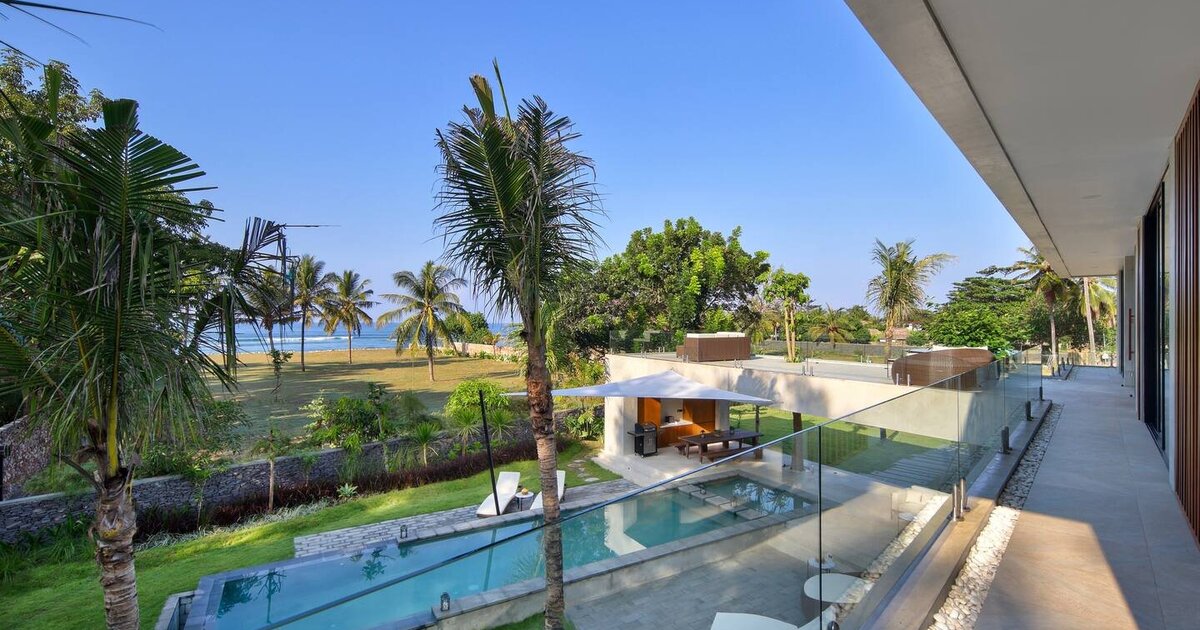
Every villa within twenty kilometres of a wave now calls itself a surf villa. The phrase has stopped meaning very much, which is a shame, because the difference between a house that genuinely works for a surf trip and one that merely sits near the coast is enormous — and you only discover it on the second morning, when the swell is up and you are still waiting for a driver.
This guide is about that difference. What a surf villa in Lombok actually needs to do, which breaks in the south suit which level of surfer, when to come, and how to make the trip work when only half your group surfs. We run two private villas set back amid gardens at Pantai Serangan, a few minutes from a reef break we surf ourselves, so the perspective here is a specific one. We have tried to keep it useful rather than promotional.
Why South Lombok, and not Bali
Lombok’s south coast has the same Indian Ocean swell window that made Bali’s Bukit peninsula famous, and a fraction of the people in the water. The coastline runs east to west in a series of deep horseshoe bays separated by headlands, which is why it holds so many different waves in such a short stretch: sand-bottomed learner beaches sit ten minutes from serious reef.
The lineups are quieter, most of the beach access is free, and you are rarely more than half an hour from something working. What you give up is convenience — fewer surf shops, fewer late-night options, rougher roads to some of the best waves. For most surfers that is a trade worth making. Our wider Lombok area guide covers how the south compares with the rest of the island if you are still deciding where to base yourself.
What actually makes a villa a surf villa
Here is what we would check before booking anywhere, ours included.
How you actually reach the water
This is the question that matters most, and listings are vague about it on purpose. “Five minutes from the beach” can mean a walk, or it can mean a drive on a road that floods, plus parking, plus a scramble. Ask specifically: on foot or by vehicle, over what surface, and does anyone need to drive you?
A surf trip lives or dies on being able to check the water at first light without organising anything. If getting to the sand involves waking a driver, you will surf less than you planned.
Whether the nearby waves suit your actual group
A break that is world-class for one person in your group and terrifying for the rest is a scheduling problem for the whole week. The strongest surf bases in Lombok are the ones with range within a short drive — something soft and sandy for the learners, something with a bit of push for the intermediates, and a proper reef for whoever needs it. Look at what is reachable in twenty minutes, not just what is out the front.
The unglamorous logistics
Nobody photographs these and they make the difference between a good week and a damp one. Ask where wet boardshorts and towels dry, whether there is somewhere sensible to leave boards, and whether boards can be hired and brought to the house rather than collected. Ask what time breakfast can realistically happen if you want to be in the water early. A villa that answers these questions plainly is a villa that has hosted surfers before.
People who know the water
Local knowledge is the most valuable amenity and never appears on the amenities list. Which break works on this tide, which one turns onshore by ten, which track is passable after rain — that comes from the team, not from a forecast app. A good host will also tell you honestly when a break is beyond your level, which is worth more than any recommendation.
The waves within reach of Selong Belanak
Our South Lombok surf guide breaks all of this down in detail, but here is the shape of it, roughly by drive time from the Selong Belanak area.
Serangan is our home break and the reason a lot of guests come. It is a right-hand reef break with long, peeling walls — uncrowded most days, punchy and hollow when a solid swell arrives. It suits intermediate and advanced surfers, works on most tides, and is at its best between April and October. It sits just off our own beach, which we will come back to below.
Selong Belanak, about ten minutes’ drive, is the beginner wave — soft, slow, sandy-bottomed, and widely rated one of the best places in the world to learn. There are surf schools directly on the beach. Mid tide is ideal, and it works year-round, which makes it the reliable fallback when the reefs are flat or blown out.
Tampah and Don-Don, roughly fifteen minutes away, are a powerful right-hand reef with long walls and the occasional barrel — intermediate to advanced, best April to October.
Mawi, twenty minutes on, is the serious one: a heavy, hollow left-hand reef that is world-class on the right swell and unforgiving when it is big. Advanced surfers only, and at its best April to September on dry-season south-westerly swells.
Mawun, also about twenty minutes, is gentler — a soft right point on smaller days, forgiving enough for improving beginners, and another year-round option.
Are Guling, around thirty minutes, offers long peeling rights that are forgiving when small and fast and fun when the swell fills in. Good intermediate territory, year-round.
Gerupuk, thirty minutes east, is the bay with everything: multiple breaks for every skill level, reached by boat, and the most consistent spot on the island. When nothing else is working, Gerupuk usually is — which is why it also sees the most surfers.
Between those seven you can build a week that never repeats itself, and put a first-timer and a lifelong surfer in the water on the same morning without either of them compromising.
Seasons, honestly
The dry season, roughly April to October, brings the strongest and most consistent Indian Ocean swell, and it is when the reef breaks are at their best. It is also the busiest and driest time to travel, with July and August the peak.
November to March is the wet season. Swell is smaller and the wind turns onshore for most of the south-facing breaks, so the reefs are less reliable — but Selong Belanak and Gerupuk work year-round, the hills are at their greenest, the water is warm, and there are far fewer people. If you are learning rather than chasing size, the wet season is a perfectly good time to come and usually better value. Our when-to-visit guide goes month by month.
When only half the group surfs
This is the situation most surf trips are actually in, and it is where a villa quietly beats a surf camp. A camp is organised around the surfing; everyone’s day bends to the tide chart. A private house lets the surfers leave at dawn and the rest of the group wake up slowly by their own pool, without either half feeling like a guest in the other’s holiday.
It also means the non-surfing days have somewhere to go. South Lombok has diving, waterfalls, boat trips to the Gilis and the quieter southwestern islands, village and culture tours, and a lot of very good, very cheap food — our experiences page lists what we can arrange, and the eating guide covers where to go locally. Families in particular tend to find this the deciding factor; our family guide has more on travelling here with children.
How our own setup works
To make the criteria above concrete, here is ours — plainly, including what we are not.
Wave Lombok is a small, family-owned pair of private villas at Pantai Serangan on South Lombok’s coast, about ten minutes by car from Selong Belanak beach. We have run it ourselves since 2022. It is not a resort and not a surf camp: no lobby, no restaurant of our own, no group van leaving at seven.
The villas sit at the back of a beachfront estate — not on the sand, which is exactly why they are quiet and green. Our land runs down to the beach, so a private path takes you to the water in about a couple of minutes on foot, entirely on our own land, and the Serangan break is roughly three minutes further along. You never leave the property to get there. The beach itself is public, as all beaches in Indonesia are — it is simply almost always empty. In practice that means you can walk down at first light with a board under your arm, look at it, and walk back up for coffee if it is not doing anything. That is the whole argument for staying here rather than a stretch of coast with a car park.
The two houses are Villa Serangan — four bedrooms, sleeps up to ten, private pool, with mountain and nature views and a partial view of the sea beyond — and Villa Selong Belanak, three bedrooms, sleeps up to eight, its own pool and a separate maid’s room, looking onto hills and forest rather than water. Take one, or both together for a larger group. The villas page has the exact room configurations.
A team of around ten people looks after the two houses, led by an on-site manager. Daily breakfast and daily housekeeping are included, and the team handles the concierge side — airport transfers, surf lessons, board hire, drivers to whichever break is working, and a private chef on request when you want dinner cooked at the villa rather than a drive after a long session. That ratio is unusual for two houses, and it is the thing guests write about most. Across Airbnb, Booking.com, direct bookings and Google the villas hold a 4.9 average across 106 guest reviews.
Three restaurants are a few minutes’ walk away and two more a five-minute drive, which matters more than it sounds when you come in at dusk and nobody wants to get back in a car.
Getting here
Lombok International Airport is roughly forty minutes away, and Kuta Lombok about thirty-five. If you are bringing your own boards, check your airline’s oversize baggage rules before you book the flight rather than at the desk — policies and fees vary a lot. Our getting-here guide covers routes and transfer times. Arrange your transfer in advance either way; it removes the one genuinely annoying part of arriving with luggage and a board bag.
If you want the wider view of choosing a villa here — service, staffing, what “luxury” is actually worth paying for — our ultimate guide to luxury villas in Lombok is the longer read, and the villa FAQ answers the practical questions we get asked most.
Before you book
Tell whoever you book with what you actually want from the trip: your level, whether anyone is learning, and how early you like to be in the water. It costs nothing to ask and it shapes the whole week — board hire sorted before you arrive, lessons booked for the right tide, and a driver arranged for the mornings the reefs are working.
If a quiet, well-staffed house a few minutes’ walk from an uncrowded right-hand reef sounds like your kind of trip, you can check availability or message us with your dates, your group and your level. We will tell you honestly what the water is likely to be doing when you come — including when it will not be doing much.
Plan your surf stay at Wave Lombok
Explore our private villa surf stays for Serangan access on foot, beginner lessons at Selong Belanak, current activity prices and a stay shaped around surfers and non-surfers together. Check villa availability or ask Salwa to help plan your stay.
Ready to see the shore for yourself?