
There is a particular kind of misery that has become part of the European summer: the flat that will not cool down, the third night of broken sleep, the shutters closed at nine in the morning against a sun that has stopped being pleasant. It is now a normal feature of July and August across much of the continent, and it has started to change where people go on holiday.
The instinctive answer is to head north, or up. That works, up to a point. But there is a second answer that almost nobody considers, because it sounds absurd on the face of it: fly south, into the tropics, where August is the coolest month of the year.
This piece is about why that is true, what the numbers actually say, and — just as importantly — what they leave out. We run two villas in South Lombok, so we have an obvious interest in the conclusion. We have tried to be honest about the caveats anyway, because a holiday sold on a half-truth is a bad holiday.
What “too hot” now means
The summer of 2026 has been the clearest illustration yet. Western Europe recorded its hottest June and July on record, averaging around 21.6°C across the two months — roughly 2.8°C above the long-term average, and past the previous record set in 2022. That average hides the peaks: air temperatures pushed beyond 40°C across the Iberian Peninsula and France, with forecasts reaching towards 45°C in the hottest parts. Slovakia recorded 42.2°C. The UK had its hottest day of the year at 38.1°C in west London. At the height of it, more than 135 million people across the continent were forecast to face further extreme heat, alongside significant wildfires.
The point is not that one summer was bad. It is that this is now the pattern, and most European housing was designed for a climate that no longer exists — thick walls and small windows built to hold warmth in, in cities that hold heat overnight and never fully release it.
The three ways out
There are really only three responses, and it is worth being clear-eyed about all of them.
Go north or go up. Norway, Scotland, the Baltic coast, the Alps and the Pyrenees genuinely are cooler, and for many people this is the right answer — short flights, no jet lag, and mountains are wonderful in summer. The honest caveats: heatwaves increasingly reach these places too, everyone else has had the same idea so prices and crowds have risen accordingly, and a cool mountain holiday is a different sort of holiday from a beach one. If what you want is to swim, this is not quite it.
Stay and shelter. Air conditioning is spreading across southern Europe but remains far from universal, and running it through a month-long heat dome is neither cheap nor especially good for the problem causing the heat dome. Most people staying put are simply enduring.
Cross the equator. This is the option that gets overlooked, because the mental model most of us carry is “tropical equals hot” — and therefore that flying towards the equator in August must make things worse. For the southern tropics, that is exactly backwards.
Why August is winter in the southern tropics
Lombok sits about nine degrees south of the equator. That is far enough south that the seasons run opposite to Europe’s, and close enough to the equator that they are mild rather than dramatic. From roughly June to September the southeast monsoon blows across the island — a steady, dry wind off the Australian landmass and the open ocean. It brings the year’s lowest temperatures, the year’s least rain, and a near-constant breeze.
The numbers are the interesting part. Official 1991–2020 averages for Mataram, on Lombok’s west coast, put August at a mean of 25.7°C, with an average daily range of 20.8°C to 30.7°C — the coolest month of the year, alongside July. Figures for the island as a whole run slightly lower again, at an average high of about 27.3°C and an average low of 23.2°C, with August recording the year’s lowest average night-time temperature. Up in the hills, on the dry-season nights when the monsoon is blowing properly, it can drop to 18 or 19°C.
Set that against a European heat dome and the comparison is not close. While Seville or Córdoba sit somewhere in the low forties, South Lombok is in the high twenties, with a sea breeze and 10mm to 20mm of rain across the whole month.
It is worth pausing on how counterintuitive that is. The tropical island is, in August, meaningfully cooler than southern Europe. Not marginally — by ten to fifteen degrees at the peak.
What the numbers leave out
Now the honest part, because a bare temperature comparison flatters us.
Humidity. Average relative humidity in August is around 78%. That matters: the “feels like” heat index for the month works out at roughly 30°C, a few degrees above the thermometer reading. Lombok in August is not crisp. It is warm, soft air that you notice for the first day and stop noticing by the third — but if what you are dreaming of is genuinely cool, dry weather, a Norwegian fjord will deliver that and we will not.
Sun. The UV index runs at 7 through August, which is high. There are around ten hours of sunshine a day and the least cloud cover of the year. That is glorious, and it will burn you in twenty minutes at midday if you are careless. Shade, a hat and real sunscreen are not optional.
Distance. This is the big one. From most of Europe you are looking at fifteen to twenty hours door to door with at least one connection, plus the time-zone adjustment at both ends. Nobody should fly that far for four nights. It makes sense as a two-week trip or longer, and it is a real cost in money, time and carbon that a train to the Alps is not.
So the accurate claim is not that Lombok is cool. It is that Lombok in August is warm in a way that is comfortable, predictable and swimmable, rather than hot in a way that is dangerous and inescapable. That is a different proposition, and a more honest one.
Why August happens to be the best month here anyway
The pleasant coincidence is that the coolest month is also, by most measures, the best month to be in South Lombok.
August is the driest month of the year — a handful of millimetres of rain against around 165mm in December. It records the most sunshine days of any month, and shares the year’s lowest cloud cover with September. The sea sits at about 27°C, which is warm enough that nobody hesitates on the way in. And the dry-season swell is at its most consistent, which is why the surf here is at its best between April and October; our surf guide covers which breaks work when.
The breeze that keeps the temperature down is the same one that makes the afternoons pleasant rather than oppressive. Our when-to-visit guide goes through the year month by month if you want to compare, and the beaches guide is honest about which stretches of coast suit which purpose — some are beautiful and busy, others need a scooter and the right tide.
How you actually live with the warmth here
Some of this is just rhythm. Mornings are the best part of the day and worth getting up for — the light is extraordinary and the water is flat. Middle of the day is for shade, a long lunch and the pool. Late afternoon the breeze comes up and everything is comfortable again. Evenings are genuinely lovely, and up in the hills the nights cool off enough to sleep properly, which is exactly the thing a European heatwave takes away from you.
The other half is where you stay. A house with deep shade, cross-ventilation, a pool you can be in at any hour and outdoor space that is usable at midday makes the difference between managing the heat and never thinking about it. Somewhere with the sea a short walk away helps more than any thermostat.
Where we come into it
To be concrete about our own setup, honestly, including what we are not.
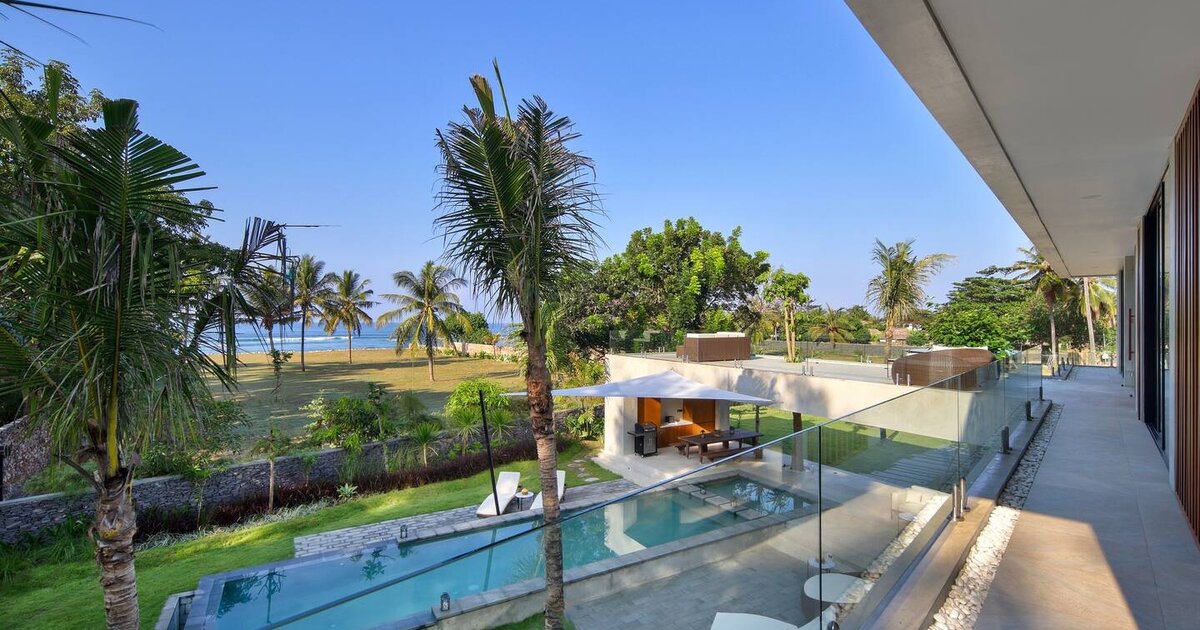
Wave Lombok is a small, family-owned pair of private villas at Pantai Serangan on South Lombok’s coast, about ten minutes by car from Selong Belanak beach. We have run them ourselves since 2022. There is no lobby, no spa and no restaurant of our own — it is two houses and a team, not a resort.
The villas sit at the back of a beachfront estate rather than on the sand, which is what puts them in the breeze and among the trees. Our land runs down to the water, so a private path takes you to the beach in a couple of minutes on foot, entirely on our own land. The beach is public, as all Indonesian beaches are; it is simply almost always empty.
Villa Serangan has four bedrooms, sleeps up to ten, and a private pool, with mountain and nature views and a partial view of the sea beyond. Villa Selong Belanak has three bedrooms, sleeps up to eight, its own pool and a separate maid’s room, looking onto hills and forest. Take one, or both together — the group stays page covers the larger configurations, and families will find the family guide more useful.
Daily breakfast and daily housekeeping are included, and a team of around ten people looks after the two houses, led by an on-site manager. They handle the concierge side — transfers, drivers, surf lessons, day trips — and a private chef can be arranged on request when you would rather not go out. Three restaurants are a few minutes’ walk away and two more a short drive; the eating guide has the detail. Across Airbnb, Booking.com, direct bookings and Google the villas hold a 4.9 average across 106 guest reviews.
Planning an August trip
Two practical notes. First, August is peak season here as well — not because of the heat elsewhere, but because it is the driest, sunniest month — so book well ahead rather than hoping. Second, allow proper time. From Europe you are looking at one or two connections, usually through Singapore, Kuala Lumpur or Jakarta, and it is worth arranging your transfer in advance; the airport is about forty minutes from us. Our getting-here guide covers the routes, and there is a dedicated page for travellers coming from the Netherlands.
If you are weighing up villas more broadly — what “luxury” is actually worth paying for, how to read a listing — our ultimate guide to luxury villas in Lombok is the longer read.
The heat in Europe is not going back to how it was. That is a genuinely sad thing, and we would not pretend otherwise. But if the last few Augusts have made you wonder whether there is somewhere else to be, the answer may be further away and considerably more comfortable than you expect.
You can check availability or message us with your dates — and if we are not the right fit, we will say so.
Ready to see the shore for yourself?