
The title is a deliberate provocation, because Bali is, of course, Indonesia — one island among thousands. But it is the island that has come to stand for the whole country, and that fame now works against it. Say “Indonesia” to most travellers and they picture Bali; book Bali, and an increasing number come home saying the same thing: beautiful, but not what I imagined. The rice terraces were there, and so were the queues to photograph them.
So the real question is not whether Indonesia beats Bali — it is whether the things people go to Bali for are now easier to find elsewhere in the archipelago. The warmth, the landscape, the gentleness of the service culture, the private pool in the green. We think the answer is yes, and we should declare our interest at once: we run two private villas on Lombok, the island immediately to Bali’s east. This piece explains why we chose it, and it tries to be honest about the trade-offs — because Bali still wins on some counts, and pretending otherwise would not help you plan anything.
What Bali promised — and what it delivers now
Bali earned its reputation the honest way. The landscape is extraordinary, the Hindu temple culture is unlike anywhere else in Indonesia, and Balinese hospitality set the standard the rest of the region still measures itself against. None of that has vanished.
What has changed is everything around it. The south of the island — where the airport, the famous beaches and most of the hotels are — has grown into something close to a continuous town. The roads between Canggu, Seminyak and Uluwatu carry more traffic than anyone building them imagined, and the beach clubs sit shoulder to shoulder along coastline that was empty within living memory. The luxury on offer is real, but it is increasingly resort luxury: polished, professional, and shared with a great many people who had the same idea.
To be fair to Bali: if your ideal trip involves restaurants of every cuisine, nightlife, galleries, yoga studios and a crowd, it remains hard to beat, and no other Indonesian island offers that density of things to do. But if the picture in your head is a quiet villa near an empty beach — the picture Bali itself planted there — the busy south of the island now struggles to provide it at any price. What you buy instead is insulation: higher walls, deeper compounds, more staff standing between you and the noise outside.
What “luxury” means once you leave the crowds behind
It helps to be precise about the word, because a luxury escape and a luxury building are not the same thing. A marble lobby is a building. The escape is made of quieter materials: space that is genuinely yours, a landscape that has not been built over, people who look after you personally rather than professionally, and — rarest of all in the famous places — the absence of other people.
We have written elsewhere about what actually separates a luxury villa from a well-dressed rental, and the short version applies doubly here: privacy, real staff, a considered build, and hosts who answer. None of those four things requires a famous island. The last one — quiet — is easier to find on an island the crowds have not reached yet.
That is the case for looking beyond Bali in one sentence: the ingredients of the escape travel well, and the crowds have not travelled with them yet.
The island next door
You do not have to go far. Lombok sits directly east of Bali — a short flight, or a boat ride across the strait — and it is the natural first answer to the question “where else?”. The two islands share the same climate and the same warm sea, but they have had very different histories with tourism, and it shows in the best possible way.
Lombok is quieter, greener at the edges, and far less built. Its south coast is a sequence of white-sand bays divided by green headlands, and most of them, most of the year, are close to empty. The beaches here are what Bali’s were a generation ago: long, clean, and yours. The surf runs from some of the best beginner waves in Asia to serious breaks for people who know what they are doing.
It is not undiscovered — nowhere with an international airport is. The Mandalika circuit hosts the MotoGP, and the corridor around it is bringing better roads and infrastructure to the south of the island. But the scale is entirely different: development here is measured in single hotels, not in districts. Kuta Lombok, the south’s small hub town, has good restaurants and a bit of an evening scene, and then it ends and the hills begin.
Practically, it is an easy island to reach and get around — our getting-here guide covers the routes. Our own villas are about 40 minutes from Lombok International Airport and about 35 from Kuta, which is far enough to be silent and close enough to be simple.
What that looks like in practice
Abstractions are easy, so here is a concrete example — our own, offered honestly.
Wave Lombok is a small, family-owned pair of private villas at Pantai Serangan on South Lombok’s coast, about ten minutes by car from Selong Belanak beach. We have run it ourselves since 2022. It is not a resort and does not try to be one: there is no lobby, no spa, no gym, no restaurant of our own. What there is instead is the thing this whole article is about — space, quiet, and a team that genuinely looks after you.
The houses
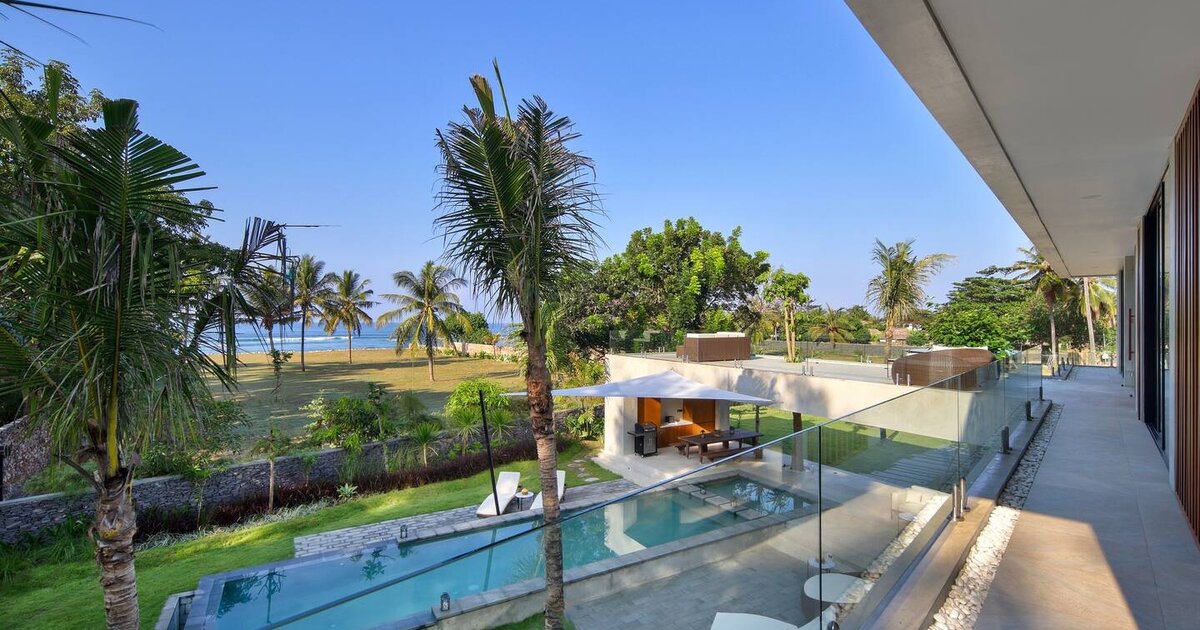
Villa Serangan has four bedrooms, sleeps up to ten, and has a private pool, with a beautiful outlook over the mountains and surrounding nature and a partial view of the sea beyond. Villa Selong Belanak has three bedrooms, sleeps up to eight, with its own pool and a separate maid’s room, framed by mountain and forest views — no sea view, and we say so, because honesty about views is rarer in this industry than it should be. You can take one house or both together for a bigger group.
The setting
The villas sit back from the sand amid tropical gardens on our beachfront estate. Our land runs right down to the shore, so a private path leads from the houses to the beach in a couple of minutes on foot — entirely on our own land, so you never leave the property. The beach itself is public, and often quiet; the Serangan surf break is about three minutes further along. This gives you a quiet garden setting at the villas and easy access to the beach, without a building between you and the shore.
The people
For just two houses, a team of about ten looks after the villas and their guests, led by an on-site manager. Daily breakfast, daily housekeeping and concierge trip-planning are included as standard, and a private chef can be arranged on request for the nights you want a proper dinner cooked at the villa. That staff-to-guest ratio is an unusual luxury at this size, and it is the one guests mention most in their reviews — the villas hold a 4.9 average across 106 guest reviews on Airbnb, Booking.com, direct bookings and Google. If you want the longer story of how a family ended up building here, it is on our story page.
The trade-offs, honestly
Lombok is not Bali with fewer people; it is a different island with a different rhythm, and it will not suit everyone.
There is no restaurant scene to speak of outside Kuta — from our villas, there are three restaurants a few minutes’ walk away and a couple more a five-minute drive, and our eating guide is honest about what is and is not here. There is no nightlife where we are, which is precisely why the nights are so dark and the stars so good. Shopping means local markets, not boutiques. And the island as a whole runs at a slower administrative pace — things work, but they work gently.
If a holiday for you means choosing a different celebrated restaurant every night, Bali is the better island and we will say so without hesitation. If it means long days between the pool, the beach and the waves, dinner cooked at home or a short stroll away, and the kind of quiet you can no longer buy in southern Bali, that is exactly what Lombok — and, we would immodestly suggest, this corner of it — does best. Families, in particular, tend to find the maths compelling: one house, one pool, one team, no crowd — our family guide covers the practicalities.
When to come
The dry season, roughly May to October, brings the most reliable sunshine and the cleanest surf, with July and August the busiest of it. April and November are quieter shoulder months and often the best value. The wet season, December to March, is the island at its greenest — short heavy showers rather than all-day rain, and the hills at their most beautiful. Our month-by-month guide breaks it down properly.
Making the choice
Strip the question back and it becomes simple. Bali offers more to do; the rest of Indonesia increasingly offers more of what the escape was for. If this trip is about restaurants, scenes and being where things happen, book Bali and enjoy it. If it is about space, water, green hills and being properly looked after in a house that is entirely yours, the archipelago now serves that better one island east.
If Lombok is the version you are imagining, you can check availability for the villas, or simply send us your dates and group — we will tell you honestly whether we are the right fit, and point you somewhere that is if we are not.
Ready to see the shore for yourself?